
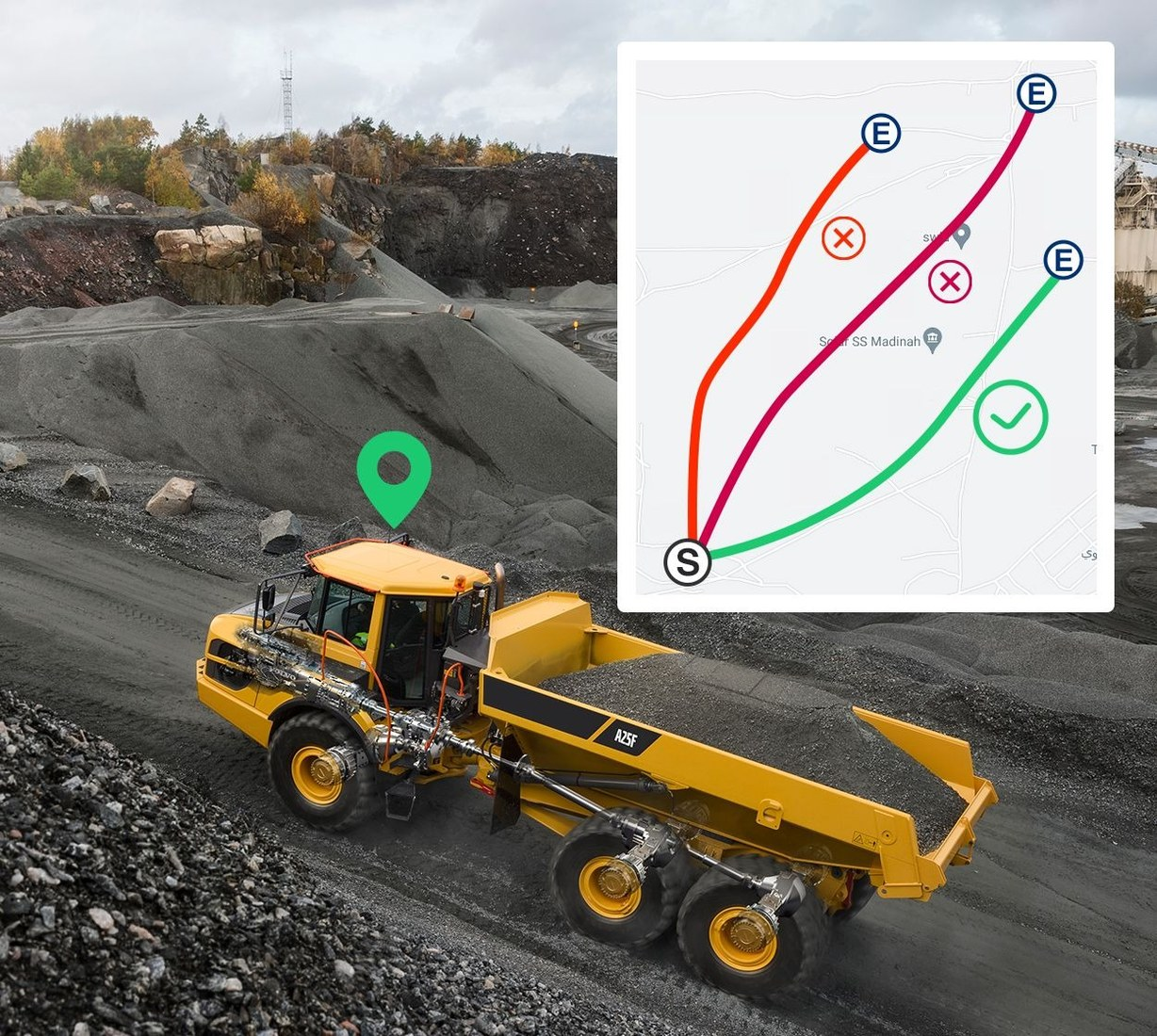
Mining haulage combines large vehicles, restricted visibility, changing work zones, uneven roads, and tightly coordinated production schedules. Safety management in this environment depends on more than knowing that a truck is moving. Operators need to understand where equipment is, how it is being driven, whether routes are being followed, and what circumstances surround abnormal events.
A mining vehicle tracking system provides the location layer for that visibility, while cameras and AI-assisted video can add behavioral and situational context. When those sources are connected with a mining dispatch system, the resulting workflow can support safer traffic control and more disciplined operational decisions without treating technology as a substitute for site procedures.

Use Location Data to Control Movement Risk
Location data gives dispatchers a consistent way to observe the movement of haul trucks, service vehicles, and other mobile assets across a site. Position, speed, route history, and geofence events can help identify congestion, unauthorized entry into restricted zones, repeated route deviations, or long stops that require investigation. The value is highest when the data is tied to site rules rather than viewed only as a moving dot on a map.
For example, a mine can define one-way haul roads, loading zones, dumping areas, maintenance areas, and exclusion zones as operational boundaries. Alerts can then be prioritized according to risk. A slow vehicle at a loading point may be normal, while an unexpected stop on a haul road or entry into a restricted area may require immediate attention. This makes the mining vehicle tracking system part of the traffic-control process.
Reliable positioning also improves post-shift review. Supervisors can compare route patterns, travel time, and repeated exceptions across vehicles. Those records can inform route design, operator coaching, or changes to dispatch rules. They can also support maintenance planning when abnormal movement patterns coincide with vehicle-health information or repeated downtime.
Connectivity planning deserves separate attention because mine sites may include pits, processing areas, workshops, and remote haul roads with uneven cellular coverage. The system should define what data is stored locally when a network is unavailable, how it is forwarded after reconnection, and which safety functions must continue to operate on the vehicle without a cloud connection.
Add Video Context to Safety Events
Video becomes valuable when a numeric event cannot explain its own cause. Speeding may reflect operator behavior, road conditions, a dispatch instruction, or an avoidance maneuver. Harsh braking may indicate an obstacle, another vehicle, or a sudden change in traffic. Road-facing and cabin cameras can give safety teams the context needed to classify events more accurately and avoid drawing conclusions from isolated telemetry.
Driver monitoring can add another layer by detecting behaviors such as fatigue or distraction when supported by the selected device. In mining operations, where blind spots and driver fatigue can create safety risks, alerts must be configured carefully so that genuine risks receive attention without overwhelming supervisors with low-value notifications. Video retention and access rules should also be defined before deployment.
For mining operations, BSJ Technology describes a solution around GPS tracking, intelligent dispatching, vehicle-health monitoring, compliance support, and AI-enabled driver safety alerts. For integrators, the relevant commercial-project question is how those hardware functions exchange data with the mine’s existing platform and operating procedures. Hardware engineering support and flexible OEM/ODM options can matter when vehicles, power systems, cameras, or communication conditions differ across sites.
Camera placement should be planned around vehicle geometry. Heavy mining equipment can require forward, cabin, side, or rear views, and the chosen positions must tolerate vibration, dust, water, and routine maintenance activity. Field validation on representative haul equipment can show whether a camera produces useful evidence in real lighting and road conditions before the installation standard is frozen.
Connect Dispatch, Safety, and Equipment Oversight
The strongest mining safety workflow combines location, video, and dispatch data instead of assigning them to separate teams. A dispatcher may identify a route conflict, a safety supervisor may review the associated video, and maintenance personnel may check whether a vehicle condition contributed to the event. Shared time stamps and vehicle identifiers make those handoffs faster and reduce ambiguity during incident review.
Real-time position data can also feed a mining dispatch system to support route and task allocation while preserving separation rules and operational priorities. The system should not automate decisions beyond the site’s approved safety controls; its role is to provide timely information, consistent alerts, and an auditable record that helps trained personnel act with better context.
For commercial mining projects, the procurement checklist should therefore cover rugged hardware, positioning reliability, camera coverage, event logic, connectivity, remote device management, integration interfaces, and technical support. Video and location data are most useful when they reinforce the same safety process. Their combined purpose is not simply to collect more information, but to make risk visible earlier and investigations more evidence-based.
Site conditions should determine which BSJ Technology capabilities need to be validated. A mining operator or integrator can verify positioning, event upload, device stability, remote configuration, and integration under representative shifts. The objective is to confirm that the proposed hardware supports the mine’s existing safety controls rather than introducing a separate process that personnel must manage in parallel.
Safety teams should define how long event evidence remains available and who can export it. A disciplined retention policy keeps storage predictable while preserving the records needed for investigation, coaching, or compliance review. The same policy should cover locally stored footage when a vehicle returns from a low-connectivity area.
