
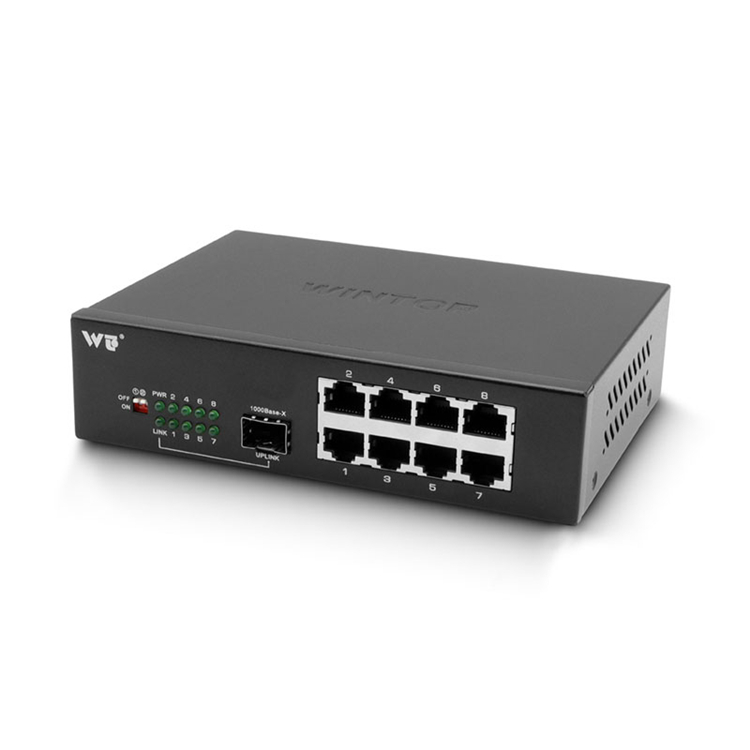
Copper Ethernet cables face severe physical limits, restricting local signal transmission to a maximum distance of one hundred meters. Integrating a 1000m media converter into a local area network resolves distance bottlenecks by transforming copper electrical pulses into optical signals suitable for fiber cabling. Physical layer translation takes place instantaneously without altering data frame structures, preserving full Ethernet throughput across extended physical links.
Network topology flexibility increases when copper endpoints interface directly with long-reach optical fiber lines. Managed switches and field devices keep their standard twisted-pair connectors while utilizing high-speed optical links to cross large campus settings. Electro-optical conversion allows system integrators to scale local networks across multi-building facilities without requiring comprehensive hardware overhauls.

Media Conversion Specifications and Bandwidth Characteristics
Throughput capability defines how efficiently media conversion hardware handles incoming network traffic. Gigabit devices process data at speeds up to one thousand megabits per second, supporting high-bandwidth applications such as high-definition video monitoring and industrial control systems. Auto-negotiation features on RJ45 ports adjust transmission speeds between ten, one hundred, and one thousand megabits based on connected host devices.
Hardware designs incorporate either fixed optical transceivers or open Small Form-factor Pluggable slots. Fixed transceiver models offer straightforward installation for fixed distances, while modular slot variants enable technicians to swap optical modules as distance requirements shift. Built-in store-and-forward switching mechanisms buffer incoming packets, minimizing frame loss during traffic spikes across connected segments.
Single-Mode Versus Multimode Fiber Compatibility
Optical media selection directly determines maximum transmission reach and system deployment costs. Multimode fiber connections utilize wider core diameters operating at eight hundred fifty nanometers, serving short-range links up to five hundred fifty meters. Commercial buildings often deploy multimode optics for internal floor-to-floor cabling where physical distances remain relatively short.
Single-mode fiber optics utilize narrower glass cores operating at thirteen hundred ten or fifteen hundred fifty nanometers to minimize modal dispersion. Deploying single-mode conversion hardware enables reliable signal delivery over distances ranging from two kilometers up to twenty kilometers. Extended transmission distance capabilities make single-mode setups ideal for connecting remote branch offices and municipal monitoring posts.
Standalone Hardware and Chassis Density Architectures
Deployment environments dictate the physical housing format selected for network media conversion. Compact standalone units fit easily inside desktop enclosures or small outdoor junction boxes, serving individual edge devices. Internal power supplies or external power adapters provide flexible power options for localized single-link installations.
High-density rack-mount chassis systems consolidate multiple conversion modules into centralized server rooms. Modular chassis designs feature redundant hot-swappable power supplies and centralized cooling, reducing maintenance complexity for large enterprises. Managed chassis systems also offer remote management capabilities, giving network engineers full visibility into individual port status and link activity.
Power over Ethernet Integration in Media Conversion
Field devices located far from AC power outlets present unique installation challenges during network expansion. Power over Ethernet media converters solve power accessibility issues by delivering electrical power and high-speed data simultaneously over a single copper cable. Edge devices such as IP surveillance cameras, wireless access points, and access control panels receive operating power directly through standard network cabling.
Power sourcing equipment standards dictate available power output per port, ranging from fifteen watts under standard PoE to sixty watts or more under high-power standards. Converting optical signals back to copper while injecting power at the edge reduces installation labor and cabling costs. Remote installations achieve clean power delivery without requiring additional electrical wiring or localized transformers.
Environmental Tolerances and Industrial Reliability
Industrial operating settings subject networking equipment to thermal fluctuations, mechanical vibrations, and electromagnetic noise. Standard commercial converters function reliably within climate-controlled office spaces, operating between zero and fifty degrees Celsius. Industrial-grade models feature reinforced metal housings engineered to withstand harsh temperature ranges from minus forty to seventy-five degrees Celsius.
Ruggedized hardware designs also include redundant DC power inputs and surge protection circuitry to maintain continuous operation during utility fluctuations. Industrial automation environments, traffic monitoring systems, and electrical substations rely on hardened media conversion hardware to prevent link failures. Choosing appropriate enclosure ratings helps prevent thermal stress and component breakdown in demanding field environments.
Key Evaluation Criteria for Network Expansion
Selecting appropriate conversion hardware requires evaluating bandwidth needs, physical transmission distance, fiber connector types, and installation environments. Matching optical wavelengths and connector types—such as Duplex LC, SC, or ST—between endpoints prevents signal loss across fiber links. System planners calculate optical power budgets to confirm that received light levels fall within specified operating ranges.
Reviewing manufacturer testing protocols and component durability provides confidence in long-term hardware performance. Compatible modular hardware solutions, such as WINTOP media conversion devices, offer flexible deployment options across varied enterprise infrastructures. Standardized testing routines verify that installed components maintain link stability across long-term operational cycles.
Conclusion
Understanding electro-optical conversion principles, fiber types, power requirements, and housing options assists network architects in building stable communication links. Deploying reliable media conversion hardware bridges legacy copper infrastructure with high-speed fiber backbones, enabling continuous network expansion across commercial and industrial facilities.
Shenzhen Wintop Optical Technology Co., Ltd. brings 21 years of specialized engineering experience as a national high-tech enterprise focused on optical communication hardware. Backed by 60 core technology patents, WINTOP produces industrial switches, PoE hardware, and gigabit 1000m media converter models like the WT-MC-1000 for clients across 40 countries. Contact technical representatives today to discuss tailored network conversion options for upcoming infrastructure projects.
