
A commercial aquatic attraction moves through several stages before guests can experience the finished ride. For developers, the on-site phase is where engineering documents, foundations, equipment, utilities, structures, and operational requirements must come together. Understanding what happens during this stage helps project owners coordinate contractors more effectively and select a water park manufacturer that can support the transition from factory production to a functioning attraction.
What Happens Before Equipment Reaches the Site?

On-site work should begin only after the project team has established the necessary design and construction conditions. A water slide is not an isolated component. ASTM F2376-24 defines a water slide system as including the flume, water-circulation system, starting platform and access, structural supports, vehicles or aquatic accessories, and termination area.
This means developers need to coordinate civil works, structural preparation, electrical systems, water supply, drainage, access routes, and equipment interfaces before major components arrive. The exact requirements depend on the attraction design and local regulations, so the project team should work from approved engineering documents rather than general assumptions.
Preparing the Construction Area
Site readiness is one of the most important factors affecting project efficiency. Foundations and supporting structures should be prepared according to the approved engineering requirements. Equipment delivery routes also need consideration, particularly when large flume sections or structural components must be moved from unloading areas to their final positions.
A practical water park construction site checklist should therefore address foundation completion, embedded components, lifting access, storage areas, utilities, drainage, safety zones, and coordination between different contractors. Resolving these issues before equipment arrives can reduce unnecessary handling and avoid delays caused by incomplete site conditions.
Coordinating the Water Slide Structure
The physical assembly of a water slide involves more than connecting flume sections. Developers should expect coordination between the flume, supporting structure, starting platform, access systems, circulation equipment, and termination area.
ASTM F2376-24 specifically includes these elements within the scope of a water slide system. This is important for business buyers because structural and hydraulic interfaces can influence both construction sequencing and final operation.
A qualified water park manufacturer can help project teams understand how factory-produced components relate to the approved site design. Clear drawings, component identification, installation instructions, and technical communication can make field assembly more manageable.
How Jinchao’s Twist Turn Slide Fits the Process
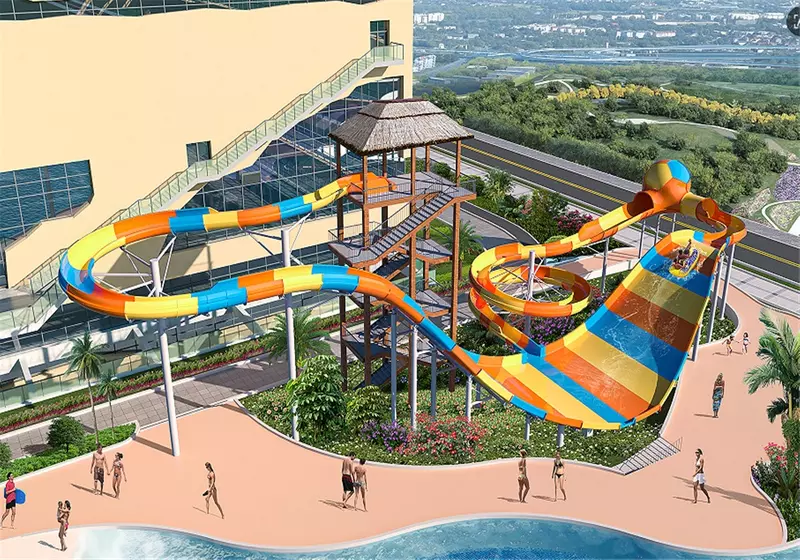
Jinchao is a professional water park manufacturer providing custom water slides for commercial water parks, resorts, and aquatic attractions worldwide. Its Twist Turn Slide illustrates why site preparation needs to begin with accurate product information.
The Twist Turn Slide has a stated starting height of 12–15 m, a slide width of 1.4–5 m, and a capacity of 2 persons per lane. Its approximate hourly capacity is 200–300 persons/hour. These specifications provide developers with useful starting parameters when reviewing the attraction’s spatial and operational requirements.
The ride starts from a 12-meter platform on a double raft. Riders travel toward the bottom, surge up the opposite slope, pass through a “magic ball,” and then slide back down. According to Jinchao’s description, lighter riders may sway back and forth during the ride, adding a distinctive dynamic element to the experience.
Managing Utilities and Hydraulic Connections
Water circulation is another critical part of the site phase. Because circulating water is fundamental to water slide systems, developers need to coordinate pumps, piping, filtration, water supply, drainage, and electrical requirements with the attraction design.
ASTM F2376-24 explicitly identifies the water-circulation system as part of a water slide system. Consequently, hydraulic connections should not be treated as an afterthought once the flume has been assembled.
During water park installation, the project team should verify that utility connections correspond with approved drawings and equipment requirements. Local codes and project-specific engineering documents should determine the final installation and inspection procedures.
Inspection, Testing, and Handover
The final phase is not simply about making the attraction look complete. The project team needs to verify structural components, connections, circulation systems, access areas, rider interfaces, and termination zones before opening.
ASTM F2376-24 covers not only design and manufacture but also construction, auditing, major modification, and operation of water slide systems. This broader lifecycle perspective highlights why commissioning and documentation matter to commercial operators.
For related attractions, the same principle applies during aquatic play equipment installation. Contractors and operators should establish inspection responsibilities, operating procedures, maintenance requirements, and documentation before the facility enters commercial service.
Choosing the Right Project Partner
For developers, the quality of field execution is closely connected to the quality of project coordination before construction begins. A capable water park manufacturer should be able to provide accurate equipment information and communicate effectively with the project team.
Jinchao’s official company information describes a manufacturing base of approximately 36,000 square meters and states that the company provides integrated planning, design, equipment manufacturing, and construction support. Its site also identifies commercial water slides and water playgrounds among its manufactured equipment.
These capabilities are particularly relevant for international projects where the equipment supplier may need to coordinate with architects, engineers, contractors, and local operating teams.
Turning Site Work Into Operational Readiness
Successful projects treat the jobsite as a continuation of the design process rather than a separate stage. Developers should confirm that foundations, structures, utilities, equipment, safety provisions, and operating requirements remain aligned throughout construction.
For a feature attraction such as Jinchao‘s Twist Turn Slide, its 12–15 m starting height, 1.4–5 m slide width, two-person-per-lane configuration, and 200–300 persons/hour approximate capacity give project teams concrete parameters for planning.
A well-prepared site can make equipment assembly more predictable, reduce coordination problems, and support a smoother transition into commissioning. For commercial developers, that preparation can ultimately help turn a technically complex attraction project into a reliable guest experience and a more manageable long-term operation.
