
For kitchenware distributors, wholesalers, and private-label brands, selecting a sink for kitchen collections requires balancing design preferences with installation requirements, durability, and purchasing costs.
In 2026, multifunctional layouts, coordinated finishes, and practical storage solutions are influencing kitchen planning. Understanding the different sink configurations helps B2B buyers build product ranges that serve different customer groups without creating unnecessary inventory complexity.
Single-Bowl and Double-Bowl Sinks Serve Different Needs

Single-bowl sinks provide one open basin for washing cookware, preparing ingredients, and handling larger kitchen items. Their straightforward configuration makes them suitable for compact kitchens and projects where usable basin space is a priority. Deep single-bowl models can accommodate larger pots and trays, although buyers should check cabinet dimensions and basin depth before selecting a product.
Double-bowl sinks divide the basin into two sections, allowing users to separate washing and rinsing activities. They may suit households that regularly perform several kitchen tasks at once. However, the divided layout reduces the space available within each bowl, which can be inconvenient when cleaning oversized cookware.
For distributors, carrying both configurations can address different installation conditions and customer preferences. Product comparisons should cover overall dimensions, bowl proportions, mounting requirements, and drainage arrangements. Clear specification sheets also help sales teams recommend suitable models for residential developments, retailers, and renovation contractors.
Workstation Sinks Support Multifunctional Kitchens
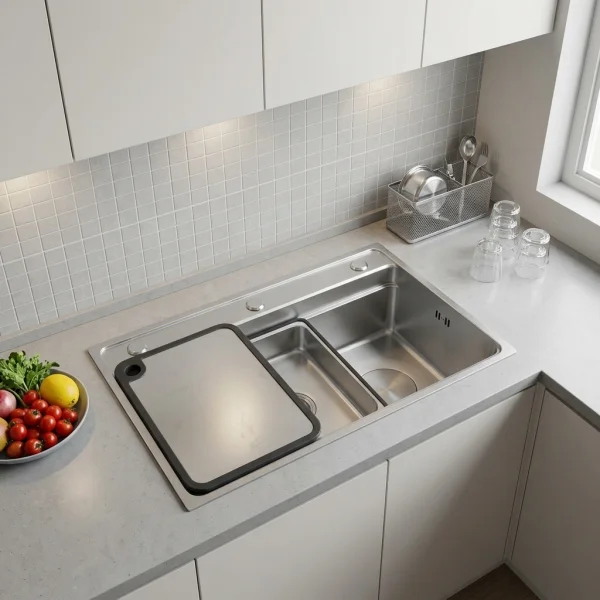
Workstation sinks combine a basin with accessories such as cutting boards, colanders, and drying racks. Some designs use integrated ledges that allow accessories to slide across different working positions. This arrangement can help users prepare food and clean utensils without relying entirely on separate countertop space.
Multifunctionality fits the broader direction identified in the National Kitchen & Bath Association’s 2026 Kitchen Trends Report, which highlights adaptable spaces, personalized layouts, and improved storage. Houzz’s 2026 product coverage also identifies workstation sinks as a continuing design development, with attention to accessory systems and larger configurations. These developments create opportunities for suppliers to offer products suited to kitchens where preparation, cleaning, and social activities share space.
B2B buyers should examine accessory compatibility, replacement availability, basin dimensions, and ease of maintenance. A product with several components may also require more detailed packaging and inventory management. Before placing a large order, distributors should confirm which accessories are included and whether the complete set matches the intended market’s requirements.
Stainless Steel Finishes and Materials Influence Product Selection
Stainless steel remains a practical material for kitchen sinks because it combines corrosion resistance with straightforward maintenance when the appropriate grade and care procedures are used. Brushed finishes can coordinate with various cabinet and countertop styles, while darker or colored surfaces offer additional options for design-focused collections.
Buyers should distinguish appearance from verified material performance. Stainless steel grades have different compositions and properties, so suppliers should identify the specified grade rather than describing all stainless steel products as equivalent. For example, the AOGLAN product range includes models featuring 316 stainless steel countertops and under-counter sinks.
For coated or specially finished sinks, procurement teams should request samples and review surface consistency, cleaning instructions, and resistance to ordinary wear. They should also confirm whether a finish can be reproduced across subsequent production batches. These checks are particularly useful for private-label brands that require consistent product appearance across multiple shipments.
Mounting Styles and Basin Shapes Affect Installation
Topmount sinks rest on the countertop, while undermount models are installed beneath it. Each approach involves different installation considerations. Topmount designs may be suitable for a range of countertop materials, whereas undermount installations require appropriate countertop construction, accurate cutouts, and suitable sealing procedures.
Round basins provide another option for particular kitchen layouts, utility spaces, and outdoor applications. Pressed sinks offer a different manufacturing approach in which the basin shape is formed from sheet material. The choice between configurations should reflect the intended application, dimensions, installation method, and required finish.
When evaluating types of kitchen sinks, procurement teams should compare technical drawings, cabinet compatibility, drainage positions, and installation instructions. These details can reduce fitting problems and help project contractors estimate installation requirements before products arrive on site.
For distributors serving different markets, it may be useful to maintain standard dimensions while offering selected alternatives for projects with specific requirements. This approach supports product variety without requiring every configuration to be stocked in large quantities.
Supplier Capabilities Matter Beyond Product Design
A commercially suitable sink must also be available in the required quantity and delivered according to an agreed schedule. For wholesalers and private-label brands, material supply, production planning, customization, inspection procedures, and after-sales support influence the total cost of sourcing.
AOGLAN is a kitchen sink manufacturer with 26 years of production experience. Its facility covers an area of over 20,000 square meters and offers more than 300 sets of sink molds. The company has a dedicated R&D and design team and provides OEM/ODM services. These capabilities may be relevant to buyers seeking customized designs or recurring wholesale supply.
Before placing an order, businesses should confirm minimum order quantities, sample approval procedures, production lead times, and quality acceptance criteria. They should also clarify packaging requirements and the process for handling defective products or replacement components. Production capacity is useful information, but buyers should verify the schedule and output available for their particular order.
Planning a Practical Sink Collection for 2026
A balanced collection can combine established single-bowl and double-bowl designs with selected workstation models, alternative finishes, or specialized configurations. Reviewing sales performance, customer feedback, and installation issues helps distributors determine which products deserve further investment.
Businesses developing a new range or reviewing existing suppliers can assess AOGLAN for its sink categories, customization services, and manufacturing capabilities. Comparing these offerings with approved samples, documented specifications, and confirmed delivery schedules supports more informed purchasing decisions as kitchen requirements continue to evolve.
