
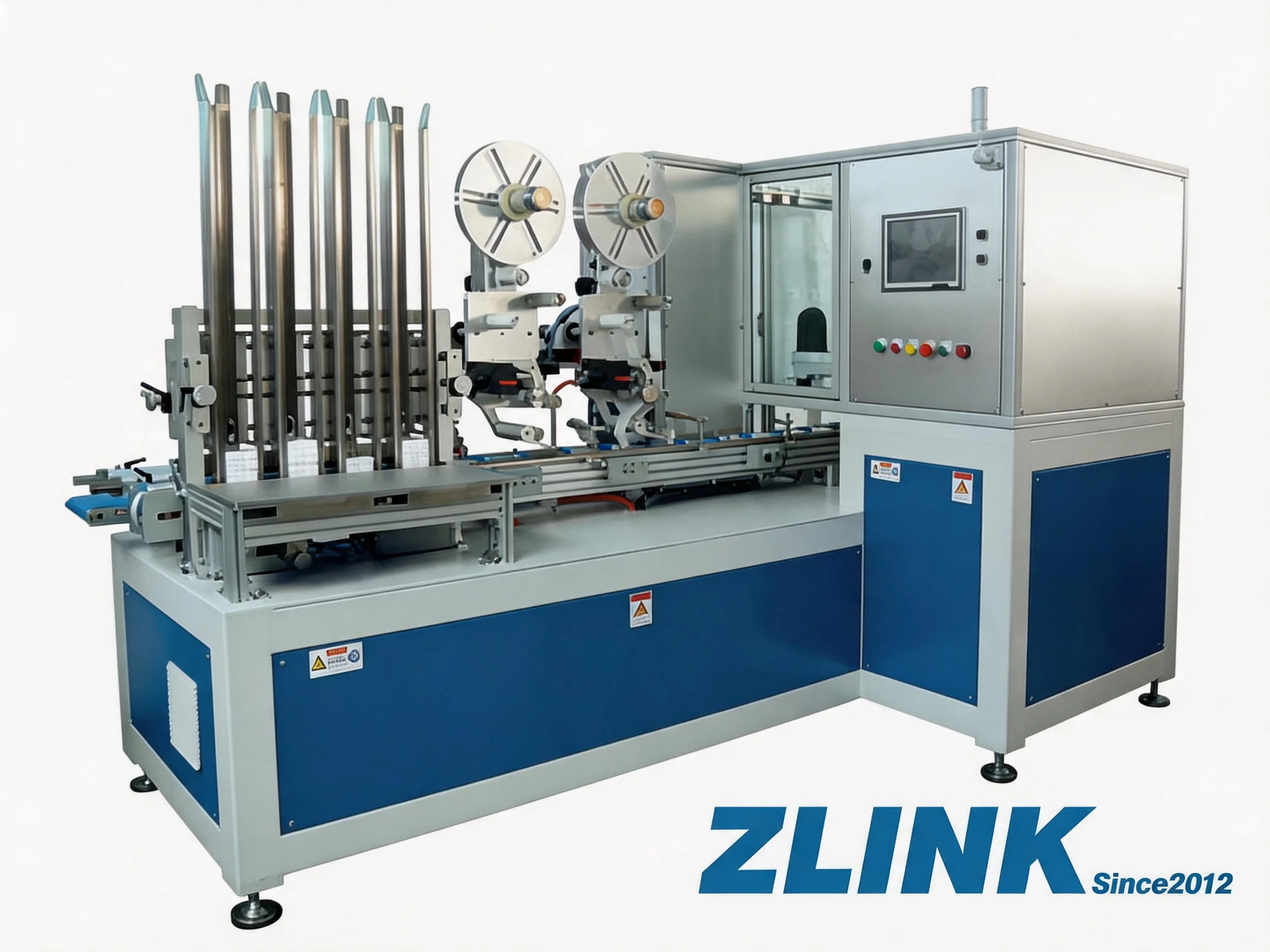
High speed production facilities manufacturing wet wipes rely heavily on automated downstream handling to maintain overall throughput and protect pack integrity. Streamlining end of line processes allows factory managers and engineering supervisors to minimize manual contact while keeping speed consistent across continuous operations.
Automated packaging machinery converts stacked substrates into market ready flow packs through precise film feeding, thermal sealing, dynamic indexing, and robotic lid attachment. As a trusted wet wipes factory automation solution provider, ZLINK provides advanced wet wipes machinery configured to integrate primary processing units with advanced downstream handling modules smoothly.
Integrating these automated downstream handling modules significantly reduces reliance on manual labor while helping maintain a cleaner and more hygienic production environment for personal care products. A well-synchronized end-of-line setup ensures that high-speed production targets are met without compromising the physical integrity of the flexible flow packs. By establishing a seamless mechanical transition from the primary converting stages to final casing, factories can minimize unexpected bottlenecks, enhance overall equipment effectiveness, and maintain rigorous hygiene standards throughout continuous shifts.

Automated Flow Wrapping and Dynamic Film Tension Control
Transitioning stacked wet nonwovens into primary packaging units requires continuous film feeding mechanisms equipped with dynamic tension controls. Servo drives regulate film unwinding to match substrate stack arrival speeds, preventing film tearing or graphic misalignment across high speed runs.
When matching flow wrapping to existing converting output, teams may review film roll diameter, splice method, printed mark tracking, and sealing jaw access. ZLINK machinery can be configured around these variables so that film tension and sealing settings remain adjustable during line speed changes.
Selecting an efficient wet wipes packaging machine enables facilities to achieve uniform hermetic seals while processing diverse barrier films and laminated foils. Dynamic sealing jaws adjust sealing temperature and contact pressure based on real time line speeds, ensuring strong longitudinal and transverse seals without film burn.
To accommodate varying packaging film structures, modern flow wrappers utilize optical registration sensors to continuously monitor printed graphics and pre-punched holes. Servo-driven film feeding mechanisms adjust lateral tracking automatically, ensuring precise alignment even during rapid acceleration or emergency stops. This dynamic control reduces material waste and prevents the barrier film from stretching or tearing during high-speed production runs.
Robotic Lid Placement and Adhesive Application Precision
Downstream from the flow wrapping module, rigid cap placement requires exact position matching to secure plastic lids over pre punched pack openings. Vision guided pick and place robotic arms detect pack coordinates continuously, placing plastic lids onto moving packages with reliable accuracy.
Thermal hot melt glue dispensing nozzles lay down precise adhesive patterns onto lid surfaces prior to mechanical placement, preventing adhesive overflow onto outer packaging areas.
Cap placement reviews may include lid size, pack opening tolerance, adhesive open time, and maintenance reach. ZLINK configurations can be discussed with vision-guided placement and hot melt settings matched to the pack format. Reviewing these details together can help reduce adhesive overspill risk and support repeatable lid positioning during changeovers.
Furthermore, the vision-guided robotic systems are equipped with high-frame-rate cameras that easily compensate for reflective packaging surfaces. The thermal hot melt adhesive units feature closed-loop temperature control to prevent adhesive stringing or premature curing. These automated applicators can be quickly reprogrammed via the touch-screen interface to handle different lid geometries and pack dimensions when changing product lines.
Integrated Quality Audit and Automatic Defect Rejection
Maintaining strict commercial compliance across high volume manufacturing runs demands continuous inspection nodes placed directly along transport conveyors.
Spectral decomposition vision sensors inspect seal width, cap placement accuracy, and graphic registration, while inline checkweighers measure total liquid content across each pack continuously.
Automated rejection stations receive signals from optical inspection nodes, instantly removing packs with poor seal integrity or incorrect fluid mass via pneumatic pushers.
Integrating an advanced RH Series wet wipes packaging machine with these inspection modules helps production teams automate defect identification and eliminate non conforming units before cartoning, protecting finished batch quality without causing secondary line stoppages.
Inline dynamic checkweighers utilize high-precision load cells to verify the exact liquid-to-substrate ratio of every individual pack. When combined with high-resolution optical sensors, the system simultaneously checks for seal integrity and label placement. Defective units are swiftly diverted by high-speed pneumatic pushers, ensuring that only fully compliant products proceed to the final cartoning stage without causing line bottlenecks.
Automated Case Packing and Centralized Line Automation
Once individual flow packs pass final vision audit, automated case packers group packs into customized collations for corrugated outer container loading. Delta robotic arms or mechanical drop packers load packed wipes gently into upright cartons, protecting flexible flow wraps from puncture or mechanical crushing.
Top and bottom carton sealing modules apply pressure sensitive tape or hot melt glue, securing shipping cases for transport and long term storage.
Dynamic sealing jaws adjust temperature and contact pressure according to line speed, helping maintain seal quality while reducing the risk of film burn.
Synchronizing these end of line modules requires central programmable logic controllers capable of managing dynamic speed variations. Touch screen human machine interfaces present clear telemetry data, displaying heating zone status, operating velocity, and cycle counts, allowing operators to switch parameters quickly during product size changeovers.
Centralized Programmable Logic Controllers (PLCs) act as the system’s core, aggregating real-time telemetry data from every module. Operators can monitor heating zone status, sealing parameters, and production speeds via intuitive Human-Machine Interfaces (HMI). This digital integration simplifies preventive maintenance scheduling and allows for rapid recipe changes, ensuring consistent output quality across diverse product batches.
