
Rental and event displays are increasingly shaped by a practical engineering problem: the same system may need to move between venues, change size, fit different stage geometry, operate under cameras, and work in either controlled indoor spaces or exposed outdoor conditions.
Those demands favor modular designs rather than installations optimized for only one permanent location. In an LED wall rental project, image performance is therefore only part of the specification.

Assembly speed, cabinet weight, service access, curve options, cabinet compatibility, brightness, protection, and refresh behavior all affect whether the display can be deployed efficiently. Current rental-display design trends can be understood by examining how these requirements are being combined in one reusable platform.
Modularity Is Moving from Simple Tiling to Reconfiguration
Traditional modular construction already allows cabinets to form a larger wall, but rental work places more pressure on the modules to support changing formats. An LED wall rental system may be required to become a wide backdrop on one day and a taller or differently proportioned surface at the next event.
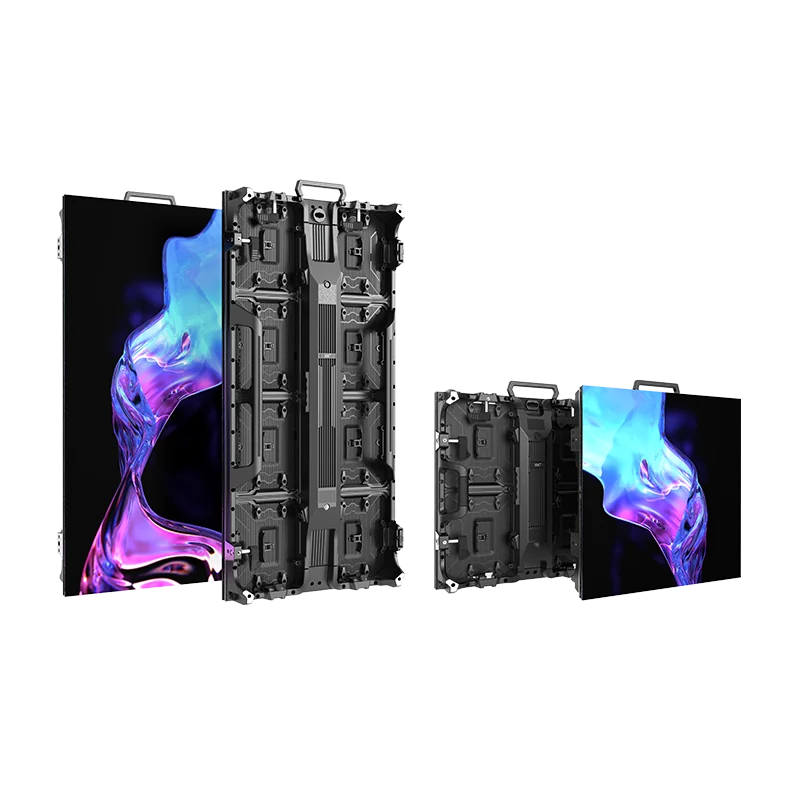
HDC‘s X Series supports mixed-size box assembly. Depending on the model, box sizes are 500 x 500 x 87 mm and 500 x 1000 x 87 mm, or 500 x 500 x 88 mm and 500 x 1000 x 88 mm. Quick assembly, lightweight construction, and maintenance access also support repeated use. Together, these features allow the system to be reconfigured for different event layouts rather than built for only one fixed arrangement.
This matters commercially because rental inventories are more useful when the same cabinet family can cover multiple event layouts. The engineering challenge is to preserve alignment and serviceability while keeping the physical system flexible enough for repeated setup and teardown.
Curved Geometry Is Becoming a Standard Design Variable
Event stages increasingly use the display surface as part of the spatial design rather than as a flat rectangle placed behind performers. That changes how cabinet geometry is evaluated.
The X Series supports 12 inner and outer arc configurations ranging from flat layouts to positive and negative curve settings. For an LED wall rental provider, such adjustability means the visual surface can follow concave, convex, or mixed stage concepts without requiring an entirely separate display platform for every geometry.
The trend is significant because curvature affects more than appearance: cabinet connections, viewing angles, alignment, and maintenance all have to remain workable when the surface changes shape.
A project designer should therefore treat arc capability as a defined mechanical function, not as an improvised installation trick. HDC’s listed 140° ±10° viewing angles also provide a relevant reference when audiences are distributed across a broad venue rather than positioned directly in front of the display.
Camera Use Is Raising the Importance of Refresh Performance
Live events are often experienced twice: once by the audience in the venue and again through cameras, recordings, or broadcast feeds. That makes refresh behavior a central technical parameter.
HDC lists at least 3840 Hz refresh for the X Series together with a 60 Hz frame frequency. In an LED wall rental context, high refresh helps address the need for stable image capture while the display simultaneously presents motion graphics, video, or live content to the venue audience.
Pixel pitch still matters, and the cited models cover 2.6, 2.97, and 3.9 mm options, but pitch should be matched to viewing distance and display scale rather than treated as the only measure of image quality. The broader trend is toward specifications that consider the complete production environment, where cameras, content systems, audience sightlines, and physical staging all interact.
Indoor and Outdoor Variants Are Converging Around a Common Platform Logic
Rental companies often need equipment that covers different venue types without creating entirely separate operating methods. The supplied X Series information includes both indoor and outdoor versions across the same general rental platform.
Outdoor variants provide IP65 protection and brightness ranges of 3500-4000 or 4000-5000 cd/m², while indoor variants are rated around 600-1000 cd/m². This does not make the two environments interchangeable; the luminance and protection requirements remain different. Instead, the trend lies in maintaining similar modular and geometric logic while adapting the environmental specification.
HDC’s approach illustrates how a rental family can preserve reconfiguration and cabinet-handling principles across controlled indoor venues and weather-exposed events. For project planners, the distinction should still be established early so that brightness, protection, and installation conditions match the actual venue.
The technology direction in rental displays is therefore less about a single headline specification and more about coordination among mechanical, optical, and operational requirements. HDC’s X Series combines mixed cabinet sizes, multiple arc settings, several pixel pitches, high refresh, indoor and outdoor variants, and service-oriented construction within one product family.
For an LED wall rental project, those features should be evaluated against the expected event cycle: transport, assembly, geometry changes, camera use, audience position, environmental exposure, maintenance, and dismantling.
A system that performs well in only one of those stages may still create operational friction elsewhere. The more useful trend is toward platforms designed around repeated change, because commercial event displays are defined by how reliably they adapt from one project to the next.
