
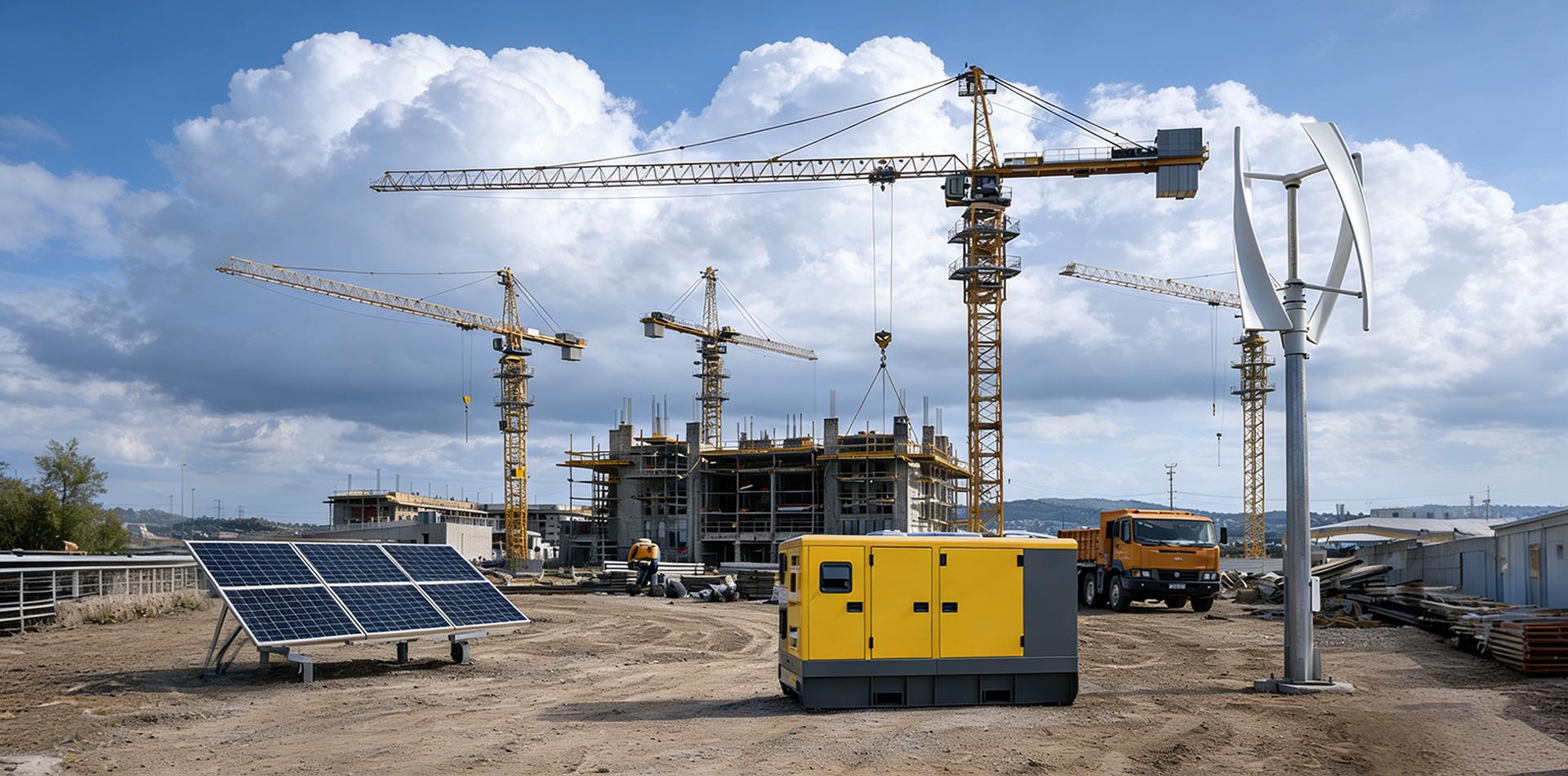
Two commercial facilities can have similar peak demand and still require very different local energy systems. One may be driven by daytime production loads and high electricity prices, while another may place greater value on backup capability, renewable self-consumption, or continued operation during grid disturbances.
Factories, industrial parks, commercial campuses, and remote business sites also differ in available space, generation mix, load criticality, and grid quality. Commercial microgrid solutions therefore need to be configured around the operating problem of the site rather than built from a single fixed arrangement. The design task begins with the relationship among loads, energy sources, storage, power conversion, and the local control layer.

Load Profiles Define the Starting Point
A site’s load pattern determines how storage and conversion equipment will be used. Facilities with strong daytime peaks may use local storage to shift energy between low-demand and high-demand periods, while sites with critical processes may reserve battery capacity for continuity during grid interruptions.
Motor loads, process equipment, HVAC systems, data equipment, and other electrical assets also differ in how quickly demand changes. Commercial microgrid solutions must therefore be sized and controlled with both steady energy consumption and short-duration power changes in mind.
A system designed only around average demand can miss the conditions that matter most during a disturbance or an operational transition, especially when the public grid is weak or temporarily unavailable. The economic objective can turn the same load profile into a different design problem.
A facility facing high demand charges may emphasize peak reduction, while a site with unstable supply may keep more stored energy in reserve. These choices affect storage capacity, converter loading, reserve margin, and control priorities, so electrical design and operating strategy need to be developed together.
Energy Sources Shape the Architecture
Commercial sites may combine utility power, photovoltaic generation, battery storage, diesel generation, or other distributed resources. The architecture changes according to which source is primary, which source is supplementary, and which resources must remain available during an outage.
In systems with substantial renewable generation, storage can absorb excess energy and later release it when production falls or demand rises. Commercial configurations used in solar-storage-diesel projects must also coordinate the operating boundaries of the battery and generator so that neither resource is treated as an independent island.
Power conversion equipment connects the DC and AC sides, while the control layer decides how those assets should respond to site conditions and operating priorities. WidenEdge’s implementation assigns MGC units to storage conversion, PV/DC and EV/DC converters to additional conversion interfaces, and Hub controllers to local coordination, bringing renewable generation, batteries, generators, and loads into one operating architecture.
Resource availability also changes over the life of a project. Photovoltaic output follows weather and daylight, generator fuel cost can change, and business expansion can shift both average demand and peak demand.
An architecture with modular energy and control functions can accommodate these changes more readily than one built around a single operating assumption. The original design therefore needs enough flexibility in conversion capacity, communications, and control logic to avoid making every later change a complete system redesign.
Grid Quality Changes the Control Requirement
A strong grid and a weak grid place different demands on local equipment. Local systems connected to a stable utility network can normally rely on that network for voltage and frequency references, but weak-grid or islanded operation requires more local support.
Grid-forming PCS becomes particularly relevant where the microgrid must establish or maintain local electrical conditions without dependable external support. A grid-forming architecture can be built around this concept so that local conversion equipment and the control layer continue supporting the site across off-grid, weak-grid, grid-connected, and hybrid operation rather than being restricted to one grid condition.
Control Turns Separate Assets Into an Operating System
Flexible hardware does not automatically create a flexible microgrid. The controller must coordinate battery power, renewable output, generator status, local loads, and the connection to the utility according to the site’s priorities.
In WidenEdge’s architecture, the Hub local controller provides that coordination layer while grid-forming PCS performs the core power-conversion role. The system can then be organized around different combinations of renewable generation, battery storage, diesel generators, and local demand.
For a factory, the operating emphasis may be continuity and demand management; for a remote commercial site, the priority may shift toward reducing diesel dependence while maintaining a stable local network. Commercial configurations become adaptable when control logic and equipment configuration reflect those differences.
Configuration Should Follow the Facility
A useful commercial microgrid is not defined by how many technologies are installed, but by whether those technologies correspond to the site’s actual energy and operating requirements.
Load shape, tariff exposure, renewable availability, grid strength, backup expectations, and the behavior of critical equipment all influence the final design. Local energy architectures that treat these variables as design inputs can be configured more precisely than a standard package built around only rated power.
WidenEdge’s platform brings storage inverters, DC-side converters, local control, and grid-forming capability into one system concept, providing building blocks for different project conditions. Commercial microgrid solutions become most effective when the architecture follows the operating logic of the facility rather than forcing the facility to fit the architecture.
SEO Title: How Commercial Microgrid Solutions Adapt to Different Energy and Operating Requirements | WidenEdge
Meta Description: Read our latest insights on How Commercial Microgrid Solutions Adapt to Different Energy and Operating Requirements. Explore loads, sources, and local control.
