
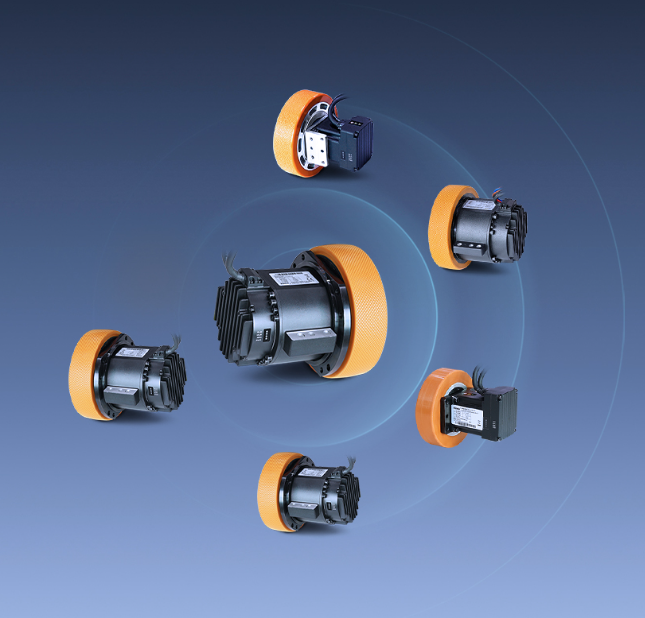
Selecting an AGV drive wheel looks straightforward until you start matching specifications to real-world conditions. Load capacity, torque output, speed requirements, floor surfaces, and control architecture all interact in ways that simple datasheet comparisons rarely reveal.
The wrong choice leads to underpowered motion, premature tire wear, or integration headaches that consume far more engineering time than anticipated. This guide breaks down the key decision points so you can match the drive component to the actual operating context.

Drive Architecture: Differential or Steered?
The first question for AGV wheels is not which wheel to buy, but how the vehicle will move. Two configurations dominate AGV and AMR chassis design: differential drive and steered (or steering) wheel drive.
Differential drive uses two independently powered wheels mounted on a fixed axis, with direction changes achieved by varying the speed of each wheel. This approach is mechanically simple, with fewer moving parts and fewer potential failure points.
It works well for point-to-point movement in structured environments and offers a lower-cost entry point. However, positioning is indirect and maneuverability is limited compared to steered systems. Differential drive is typically suited for light- to medium-load applications, with payloads usually below 500 kg.
Steered wheel drive, by contrast, integrates driving, steering, and load-bearing functions into a single module. An independent steering mechanism changes the wheel’s direction directly, eliminating reliance on wheel speed differentials. This delivers higher precision, superior maneuverability, and stronger load capacity.
Integrated servo steering systems can achieve positioning accuracy up to ±5 mm. The trade-off is higher system complexity and cost. For demanding applications with heavy payloads or complex navigation requirements, steered drive is the mainstream choice.
Load, Torque, and the Margin That Matters
Once the architecture is set, the real specification work begins. Load capacity is the most visible parameter, but it is rarely as simple as matching the vehicle’s weight. The drive wheel must support the AGV’s self-weight, the maximum payload, and the dynamic loads that occur during acceleration, braking, and operation on inclined surfaces.
Torque requirements follow directly from load and motion profile. An integrated drive system typically consists of four components: the drive wheel, motor, gear reducer, and servo drive. The gearbox reduces motor output speed while multiplying torque. Selection must account for both continuous duty cycles and peak loads.
A frequently underestimated risk is insufficient torque margin. Datasheet ratings assume ideal conditions. Real-world factors—floor irregularities, varying friction, voltage drops, and temperature changes—all reduce effective output.
A practical engineering guideline is to maintain a 20–30% torque reserve, ensuring stable performance under non-ideal conditions. For a 1,500 kg vehicle, static wheel load on the traction wheel may reach 800 to 1,000 kg depending on chassis geometry, and applying a service factor of 1.5 is common practice.
Wheel diameter also matters. Typical diameters range from 100 mm to 300 mm for warehouse applications. Larger diameters reduce rolling resistance and improve obstacle clearance but increase inertia, which raises the torque required from the motor. The material and hardness of the tire—typically polyurethane for industrial AGVs—affects traction, wear life, and floor compatibility.
Speed, Surface, and Operating Environment
Linear speed requirements directly influence motor and reduction ratio selection. Warehouse AGVs typically operate at modest speeds, but some applications demand faster transport. Rated linear speeds for integrated servo wheel modules commonly range from 1.5 m/s to over 3.9 m/s, with maximum speeds extending higher.
Floor conditions are equally critical. Smooth concrete, epoxy-coated surfaces, and uneven warehouse floors all present different friction characteristics. Tire hardness ratings—expressed in Shore A—affect grip and wear. Softer compounds (around 73A) provide better traction on smooth surfaces but wear faster. Harder compounds (up to 93A) last longer but may sacrifice grip on slippery floors.
Environmental factors also constrain the choice. Operating temperature ranges, humidity, and altitude all affect both motor and electronic component performance. For example, some integrated servo wheel modules are rated for operation from -20°C to +40°C, with derating required above 1,000 meters altitude.
Protection ratings like IP54 indicate resistance to dust and water splashes, which matters in washdown environments or dusty warehouses.
The Integration Question: Modular vs. All-in-One
Traditional AGV drive systems use discrete components: a servo motor, a separate gearbox, a stand-alone servo drive, and a wheel assembly mounted to a chassis bracket. Each component is sourced individually, wired separately, and integrated during vehicle assembly.
This approach offers flexibility in component selection but introduces complexity—cable routing, mounting alignment, and system reliability all become engineering tasks rather than solved problems.
Kinco‘s integrated servo wheel modules address these pain points by combining the servo drive, motor, planetary gearbox, and polyurethane tire into a single compact assembly. The all-in-one design eliminates separate wiring between drive and motor, reduces mounting footprint, and simplifies the bill of materials. For mobile robot developers, this translates to faster assembly, more consistent build quality, and reduced system integration complexity.
The trade-off is modularity. A discrete system allows individual component upgrades or replacements. An integrated unit must be specified correctly from the start, with the understanding that the entire assembly is replaced if any component fails.
However, for production-volume AGV and AMR platforms, the benefits of reduced assembly time, smaller footprint, and improved reliability often outweigh the loss of component-level flexibility.
The right AGV drive wheel is the one that matches not just the vehicle’s weight, but its motion profile, floor surface, operating environment, and assembly workflow. Start with the drive architecture that fits the maneuverability requirement. Calculate load and torque with a realistic safety margin.
Consider speed and environmental constraints early. Then decide whether modular flexibility or integrated simplicity better serves the production and maintenance strategy. Each choice builds on the previous one, and getting the sequence right is what separates a successful deployment from a costly redesign.
