
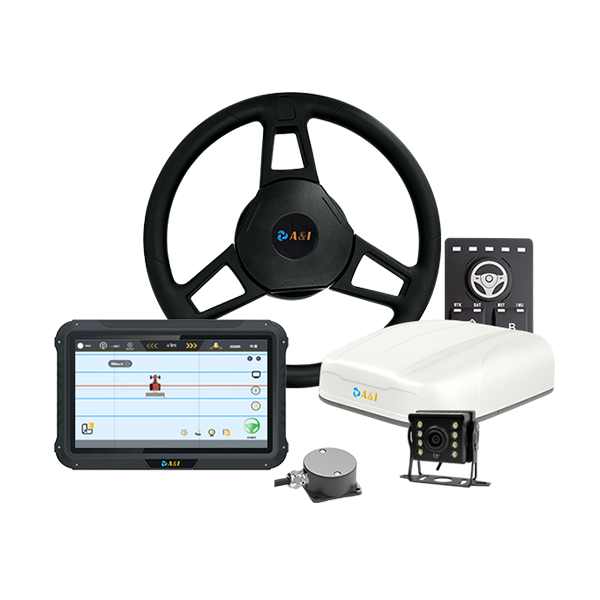
Modern precision farming depends on accurate navigation and stable vehicle control. A reliable tractor autosteer system allows agricultural machinery to follow planned paths with minimal overlap and reduced manual steering effort. By combining GNSS positioning, onboard sensors, and intelligent control software, these systems help operators improve field efficiency and maintain consistent working accuracy.
Understanding GNSS-Based Steering Control
An auto-steering system uses signals from multiple satellite constellations, including GPS, BeiDou, Galileo, and GLONASS, to determine the exact position of a vehicle in the field. The receiver continuously calculates the tractor’s location, heading, and movement speed. RTK correction technology further improves positioning precision to centimeter-level accuracy.
The control terminal compares the real-time vehicle position with a predefined guidance line. If the tractor drifts away from the planned route, the system automatically calculates the required steering correction. The steering motor or hydraulic steering controller then adjusts the wheels to bring the vehicle back onto the correct path.

How Direction Correction Works
The steering controller receives constant GNSS updates while monitoring vehicle movement. Algorithms process positioning data together with information from inertial sensors and wheel angle measurements. This allows the system to maintain stable steering even on uneven terrain or during temporary signal interference.
Many agricultural GPS guidance systems also support multiple guidance modes such as straight lines, curves, and adaptive paths for irregular fields. Automated U-turn functions can assist operators when reaching field boundaries, improving operational consistency during seeding, spraying, and harvesting.
Benefits for Precision Agriculture
A modern tractor autosteer system reduces driver fatigue and supports longer operating hours, including nighttime work. Accurate steering minimizes overlap and missed areas, helping reduce fuel usage, seed waste, and chemical application errors.
At Archimedes Innovation, systems such as the AS10 integrate high-precision GNSS technology with intelligent steering control for various agricultural machinery applications. The platform supports multiple guidance modes and RTK correction services to maintain reliable field navigation.
Conclusion
GNSS-based steering systems combine satellite positioning, correction data, and intelligent control algorithms to maintain accurate vehicle direction during field operations. As agricultural GPS guidance systems continue to evolve, they provide farmers with practical tools for improving efficiency, operational accuracy, and consistency across precision agriculture tasks.
