
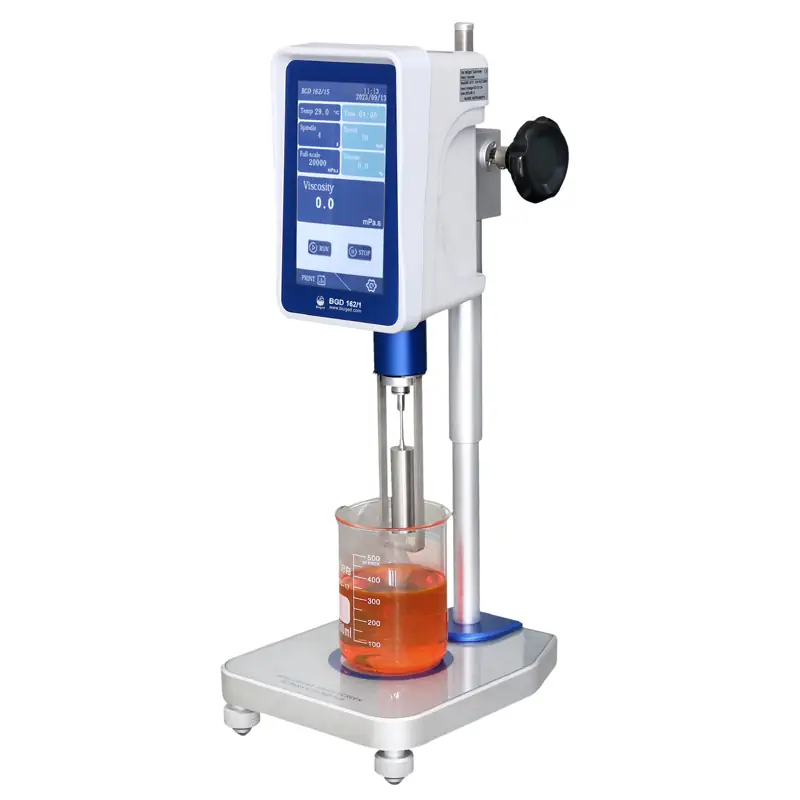
Spindle selection is a key part of rotary viscosity testing rather than a minor setup choice. Spindle geometry, measuring range, rotational speed, sample volume, and test method all influence the result. Matching these factors helps laboratories produce measurements that are more repeatable and useful when comparing coatings, inks, polymers, adhesives, and related materials.
Why Spindle Selection Matters

A rotary viscometer measures resistance to flow through the interaction between a rotating spindle and the sample. Different spindle shapes and sizes create different shear conditions, so the same material can produce different readings under different configurations.
This is particularly important for non-Newtonian materials. Many coatings, inks, adhesives, emulsions, and polymers do not maintain a constant viscosity as shear conditions change. A viscosity value therefore becomes meaningful when the spindle, speed, temperature, and measurement procedure are clearly defined.
For routine quality control, selecting a spindle simply because its nominal range covers the sample may not be enough. The setup should also fit the material behavior and the purpose of the test.
Start With the Expected Viscosity Range
The first step is to estimate the sample’s viscosity under the intended test conditions. A spindle operating too close to the limits of its range may be less useful than one working within a more suitable measurement window.
The range offered by BIUGED INSTRUMENTS provides an example of this principle. Its BGD 162 Intelligent Touch-screen Rotary Viscometer is available in configurations with different measurement ranges and uses LV1, LV2, LV3, and LV4 rotors, with an LV0 option. The BGD 162/1 covers 10–100,000 mPa.s, while the BGD 162/2 covers 10–2,000,000 mPa.s. Such configurations allow laboratories to select a rotor and instrument range appropriate to the material being evaluated.
Match Spindle Geometry to the Method
Spindle geometry affects the shear conditions applied to a sample, so shapes should not be treated as interchangeable. Disc, ball, cylinder, and cone geometries can be associated with different measurement procedures and flow behaviors.
The BGD 180 Intelligent Touch-screen Rotothinner shows how spindle choice can change the test conditions. It includes three spindle designs: a No. 1 disc spindle for viscosities up to 2,200 mPa.s at approximately 200 s⁻¹ with a Newtonian fluid, a No. 2 big-ball spindle up to 7,500 mPa.s at approximately 44 s⁻¹, and a No. 3 small-ball spindle up to 35,000 mPa.s at approximately 20 s⁻¹. The instrument is designed to comply with ISO 2884-2 and BS 3900 A7.
These differences mean spindle selection should follow the chosen standard and testing objective. A configuration suited to a higher-shear measurement may not produce directly comparable results in a lower-shear procedure.
Consider Non-Newtonian Behavior
For non-Newtonian materials, viscosity may change as shear conditions change. Spindle selection therefore needs to be considered together with rotational speed. Comparing samples at different speeds or spindle configurations can produce differences caused partly by the test setup rather than the material.
A consistent method should document the spindle, rotation speed, temperature, test duration, and sample conditioning. For thixotropic materials, timing can also affect reading because apparent viscosity may change during shearing.
The company’s programmable viscometer information notes that rotational speed and spindle shape influence shear rate in coatings, inks, adhesives, resins, and emulsions. Controlled settings are therefore important when evaluating shear thinning or thixotropy.
Keep Sample Conditions Consistent
A suitable spindle cannot compensate for inconsistent sample preparation. Temperature, sample volume, air bubbles, mixing history, and rest time can all affect viscosity measurements.
The procedure should specify how the sample is prepared and conditioned before measurement. Spindle position should also remain consistent, and operators should avoid bubbles or contact between the spindle and container.
When a standard container is specified, following its dimensions can further reduce variation. The BGD 180, for instance, uses a 250 mL container with a 74 mm internal diameter and 74 mm height, providing a defined setup for its measurements.
Document the Complete Test Configuration
Spindle selection becomes more useful when supported by calibration and clear records. Laboratories comparing batches should retain the instrument model, spindle identification, speed, temperature, sample information, and calibration status. This helps determine whether a change in viscosity comes from the material or from the testing process.
When purchasing rotational viscometers, laboratories should therefore evaluate more than the headline viscosity range. Spindle options, speed control, temperature management, repeatability, data handling, applicable standards, and technical support all affect practical performance.
A Practical Selection Routine
A simple routine can make spindle choice more consistent. First, identify the governing standard and the property being measured. Next, estimate the expected viscosity at the actual test temperature. Then select the spindle and speed required or supported by the method. Finally, record the complete configuration so another operator can reproduce the test.
This is especially valuable when results must be compared across batches, laboratories, or production sites. A number becomes more useful when the conditions behind it are transparent and repeatable.
Improving Rotary Viscosity Testing
Spindle selection is ultimately part of method control. Matching spindle geometry and range to the material, maintaining consistent sample conditions, and documenting the test configuration can help separate genuine formulation differences from measurement variation. BIUGED INSTRUMENTS develops laboratory testing equipment for viscosity and other coating, ink, and material evaluation applications, with multiple rotary viscometer configurations for different measurement needs and standards.
For laboratories seeking a more consistent viscosity testing workflow, BIUGED INSTRUMENTS provides equipment adaptable to different spindles, speeds, and measurement requirements.
