
For decades, successful dairy production has relied on mastering genetics, nutrition, and feed management. Today, a fourth, equally critical factor has emerged as a key driver of profitability: the controlled lighting environment. The practice known as Long-Day Lighting (LDL) leverages a cow’s natural biology to consistently and reliably increase milk yield by an average of 8% to 10%.
The question is no longer if you should use it, but how to implement it with a reliable, purpose-built cow lighting system. LDL is a strategic environmental management tool that treats light as a nutrient, providing the precise energy required to optimize hormonal function, increase feed intake, and enhance overall herd performance.
Long Day Lighting in Dairy Barns: The Strategic Pillars
Long-Day Lighting is defined by an exact, non-negotiable photoperiod—the balance between light and dark hours—that must be maintained with high-quality fixtures and controls. Achieving the LDPP effect relies on mastering three distinct strategic pillars:

1. The Right Duration (16:8 Cycle)
The optimal LDPP for lactating cows is:
- 16 to 18 hours of bright, consistent light.
- 6 to 8 hours of uninterrupted, deep darkness.
This extended light exposure is critical because it suppresses the nightly secretion of melatonin, the “darkness hormone.” By keeping melatonin levels low, the cow’s body is signaled to produce more Insulin-like Growth Factor-1 (IGF-1), which directly stimulates the mammary glands. Without the strict 16:8 cycle, the hormonal mechanism fails, rendering the lighting investment ineffective.
2. The Right Intensity (150–200 Lux)
Light must not only be long enough but also bright enough to fully suppress melatonin. The industry and scientific consensus requires a light intensity between 150 and 200 lux (or 15 to 20 foot-candles), measured at the cow’s eye level.
Crucially, uniformity across the barn floor is essential. Shadows or patchy light distribution mean certain cows may not receive the minimum required lux level, disrupting their hormonal cycle and creating inconsistencies in the herd’s performance. Achieving this high, consistent intensity requires high-efficacy fixtures designed to direct light accurately.
3. The Right Quality and Consistency
A successful LDPP system must deliver light that is flicker-free and controllable. Flickering light, even if imperceptible to the human eye, can cause stress in animals. Furthermore, the light must transition gradually, simulating natural sunrise and sunset.
Abruptly snapping lights on and off at 150 lux is a stressor that can cause cows to stop feeding or become agitated. Professional cow lighting systems utilize flicker-free dimming to smoothly ramp up light levels over 20-30 minutes, minimizing stress and maintaining consistent feeding behavior.
Biological and Behavioral Advantages of LDPP
Beyond the direct hormonal increase in milk yield, the use of LDL delivers significant secondary benefits that boost overall farm management and cow welfare:
- Increased Dry Matter Intake (DMI): Cows spend more time actively feeding and less time standing around in the extended light hours, fueling their higher metabolic needs. Increased feed consumption is a direct prerequisite for the higher milk output.
- Improved Reproductive Performance: High-quality lighting makes cows more active and visible, dramatically improving the ability of herdsmen to detect estrus (heat). Better estrus detection leads to shorter calving intervals, a primary driver of sustained profitability.
- Better Worker Visibility and Safety: Maintaining 150–200 lux during working hours improves barn visibility for staff, enhancing safety and supporting better hygiene practices and quicker detection of health issues.
The Dual Strategy: Lighting Management for Dry Cows
A major pitfall in LDL implementation is failing to manage the dry cow phase correctly. For a lactating cow to respond optimally to LDPP, her photoreceptor system must first be reset during the dry period.
This is achieved using a Short-Day Photoperiod (SDPP):
- 8 hours of bright light (150–200 lux).
- 16 hours of continuous, deep darkness.
This SDPP dramatically increases melatonin levels, which has been linked to improved udder health and immune function leading up to calving, setting the stage for a highly productive next lactation. Successfully implementing both LDPP and SDPP simultaneously requires a robust, two-zone control system and highly durable fixtures capable of withstanding the harsh environment of both milking and dry cow facilities.
The szAMB Solution: Engineered for Harsh Dairy Environments
Implementing a precision LDPP program demands lighting equipment built not just for longevity, but for the specific demands of a dairy barn—high humidity, corrosive ammonia, and daily power washing.
szAMB specializes in engineered lighting systems that make the successful management of long day lighting in dairy barns possible year after year. Their cattle lighting solutions are designed to deliver the required high intensity and durability without failure.
Reliability Meets Performance
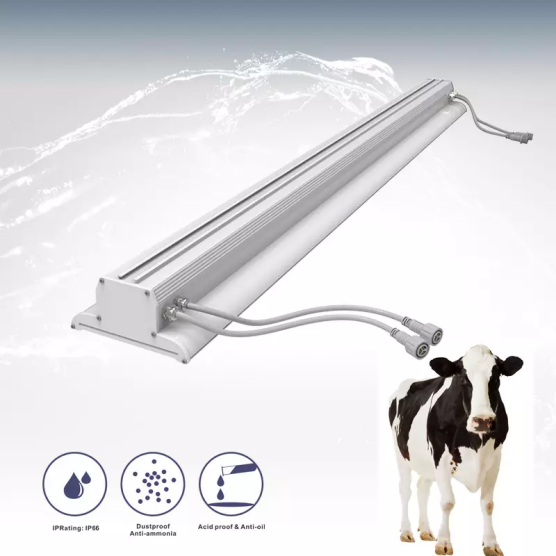
- Ultimate Durability: szAMB offers fixtures like the IP69K Tri-proof LED Light and the IP65 Rated LED Linear Highbay. The IP69K rating is critical, certifying the fixture to withstand direct jets of high-pressure, high-temperature water (used in washdowns) without damage. This is essential for maintaining hygiene and ensuring the system’s longevity.
- High Efficacy: szAMB fixtures are built with high luminous efficacy (up to 140 lm/W), ensuring that the energy consumed is efficiently converted into the required 150–200 lux level, driving down operational costs and maximizing ROI.
By choosing a dedicated, high-specification cow lighting system from a specialist like szAMB, dairy producers are not merely buying light fixtures; they are investing in a proven, sustainable method of boosting milk production, improving animal welfare, and driving the long-term profitability of their farm.
