
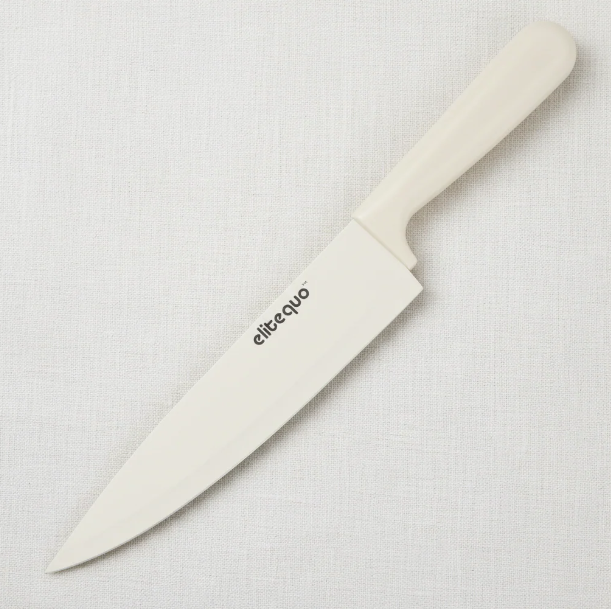
In the competitive world of culinary tools, the debate over the perfect blade length is a rite of passage for every home cook. While professional kitchens often resemble a landscape of various stee l lengths, the average consumer is typically faced with a singular, crucial choice: the versatile 8 inch chef knife or the commanding 10 inch blade.
At Elitequo, we believe that the right tools are the foundation of kitchen confidence. Understanding the nuances between these two sizes is not just about measuring steel; it’s about matching a tool to your hand size, workspace, and the ingredients you love to prepare.
1. The Versatility of the 8 Inch Chef Knife
The 8 inch chef knife is widely considered the “golden standard” for the modern home kitchen. It offers a precise balance that strikes the middle ground between a nimble paring knife and a heavy-duty cleaver.

For the average consumer, this length provides enough surface area to handle approximately 90% of daily kitchen tasks. Whether you are mincing delicate shallots or dicing a pile of carrots for a weekend stew, the 8-inch blade provides a “sweet spot” of control. At Elitequo, our 8-inch models, such as those in the Skyline Glow and Slate Edge series, are engineered with high-carbon German stainless steel to ensure that this versatility is backed by an edge that stays sharp through hundreds of meal preps.
2. The Power of the 10 Inch Blade
While the 8-inch is the crowd favorite, the 10-inch chef knife is a powerhouse designed for efficiency. The extra two inches of steel allow for a longer “draw,” which means you can slice through large proteins or dense vegetables like butternut squash and watermelons in a single, clean motion.
However, the 10-inch blade comes with a learning curve. Because of the increased weight and length, it requires more wrist strength and advanced knife skills to maneuver safely. In a professional setting where chefs process fifty pounds of onions a day, the 10-inch blade is an efficiency king. For the home chef, it is often seen as a specialized tool for those who frequently host large gatherings or practice “batch cooking” on Sundays.
3. Precision vs. Efficiency: Why You Should Choose a Chef Knife Based on Technique
The primary difference between these two sizes often comes down to your preferred cutting style. A chef knife is designed with a “belly”—a curved edge that allows for a rocking motion.
The 8 Inch Advantage: The shorter arc of an 8 inch chef knife makes it incredibly responsive for “rock-chopping” herbs or nuts. It feels more like an extension of your hand, offering the tactile feedback necessary for precision cuts.
The 10 Inch Advantage: The longer blade provides more leverage. If you prefer the “push-cut” method (moving the blade forward and down), the 10-inch blade does more of the work for you, using its own weight to glide through thicker ingredients.
4. Ergonomics and Hand Size: The Elitequo Standard
One of the most important factors in choosing a knife is how it feels in your palm. A knife that is too large for your hand can lead to premature fatigue and, more importantly, a lack of control that can lead to accidents.
Elitequo designs its knives with consumer ergonomics at the forefront. Our 8 inch chef knife collections feature handles crafted shaped to fit the natural contours of the hand. For most home cooks, the 8-inch size aligns perfectly with the standard reach of the forearm, preventing the “clunky” feeling that a larger 10-inch blade can produce in a smaller kitchen workspace.
5. Practicality: Counter Space and Storage
Beyond the blade’s performance, practical kitchen logistics play a role. An 8-inch knife is generally more compatible with standard-sized cutting boards and drawer inserts. If you are working in an urban kitchen with limited counter real estate, a 10-inch knife can feel cumbersome, often hitting the backsplash or surrounding appliances during use.
Furthermore, most self-sharpening blocks—a signature feature of Elitequo sets like the Night Flash series—are optimized for the 8-inch standard. Having a tool that fits perfectly into your storage and maintenance routine ensures that you will actually reach for it every time you cook.
Technical Specifications: What to Look For
Regardless of the length you choose, the quality of the steel remains the most critical factor. When shopping for an Elitequo chef knife, look for these key specifications:
Blade Material: Premium High-Carbon Stainless Steel, heat-treated for a perfect balance of edge retention and corrosion resistance.
Unique Glow Handle: Features a signature luminous (Glow-in-the-dark) handle design, providing not only a striking aesthetic but also an ergonomic grip for fatigue-free cutting.
Full-Tang Strength: Built with a solid full-tang construction, where the blade steel runs entirely through the handle for superior balance and lifetime durability.
Final Verdict: Which Is Best for You?
The decision between an 8 inch chef knife and a 10 inch blade ultimately rests on your personal comfort level and the “scale” of your cooking.
If you are a beginner or an intermediate home cook who values agility, safety, and a tool that can handle everything from garlic to chicken, the Elitequo 8 inch chef knife is your best bet. It is the workhorse that won’t let you down.
However, if you are an experienced cook with larger hands, ample workspace, and a passion for processing large quantities of food, the 10-inch blade offers a level of professional power that can significantly speed up your prep time.
At Elitequo, we are dedicated to helping you find your “forever knife.” Explore our curated Chef Knife Collection to find the perfect length, weight, and style for your culinary journey. Whether you choose the nimble 8 or the mighty 10, your kitchen experience is about to be elevated.
